

GBN talks to Justin Giles and Kevin Mayoux, co-founders of UpSwing Golf, a newly launched equipment brand that has developed a unique junior golf club system that grows with the golfer, saving parents significant sums in sizing up while also creating an attractive proposition for golf retailers
GBN: Where did the seeds of the idea for UpSwing Golf first come from?
Justin: The idea for UpSwing really came from a very simple problem. I was looking for golf clubs for my young son and quickly realised how limited the options were.
What struck me was that there seemed to be a better way. Why couldn’t we build a premium junior golf system that actually grew with the player, rather than expecting parents to replace an entire set every time their child grew?
That was where Kevin’s engineering background came into the picture. I had identified the problem from a parent’s perspective, while Kevin could look at it from a design and performance perspective. The challenge wasn’t simply making a shaft longer; we needed to make sure the club continued to perform properly as the golfer grew, maintaining the right weight, balance, feel and overall playing characteristics.
That combination of a genuine parental problem and an interesting engineering challenge was really the starting point for UpSwing. From there, we set out to create something that would give young golfers properly fitted, performance-focused equipment throughout their development, while giving parents a much smarter long-term investment.
What were your previous professional backgrounds and how have they helped with the setting up of UpSwing?
Justin: Before UpSwing, Kevin and I came from quite different professional backgrounds, but those differences have proved to be one of our biggest strengths. My background is in business and entrepreneurship, while Kevin is a mechanical engineer with product design and development experience across leading golf companies including Adams Golf, Wilson Sporting Goods and Inesis Golf.
Kevin’s engineering and golf industry experience has given him a strong understanding of how equipment needs to be designed, tested and refined to perform consistently, while my commercial background has helped us stay focused on the customer and the wider market opportunity.
That combination has been particularly important with UpSwing. We weren’t simply trying to create another junior golf club. We identified a genuine problem with the way junior equipment is traditionally designed and sold and then had to develop an engineering solution that would work in the real world. Bringing those two perspectives together has allowed us to approach UpSwing as both an engineering challenge and a genuine market opportunity.

What were the biggest technical and development challenges involved in creating clubs that can be adapted to suit junior golfers as they grow?
Kevin: The first step was recognising that making a club longer or shorter wasn’t enough. If you change the length of a golf club, you also change its overall weight, balance and swing characteristics, so simply adding length can create a club that is physically the right size but doesn’t perform correctly.
Our biggest technical challenge was therefore developing a system that could accommodate a child’s growth while maintaining the characteristics of a properly designed golf club. We had to look at the relationship between shaft length, clubhead weight, swing weight, balance and the way those elements influence how a young golfer delivers the club.
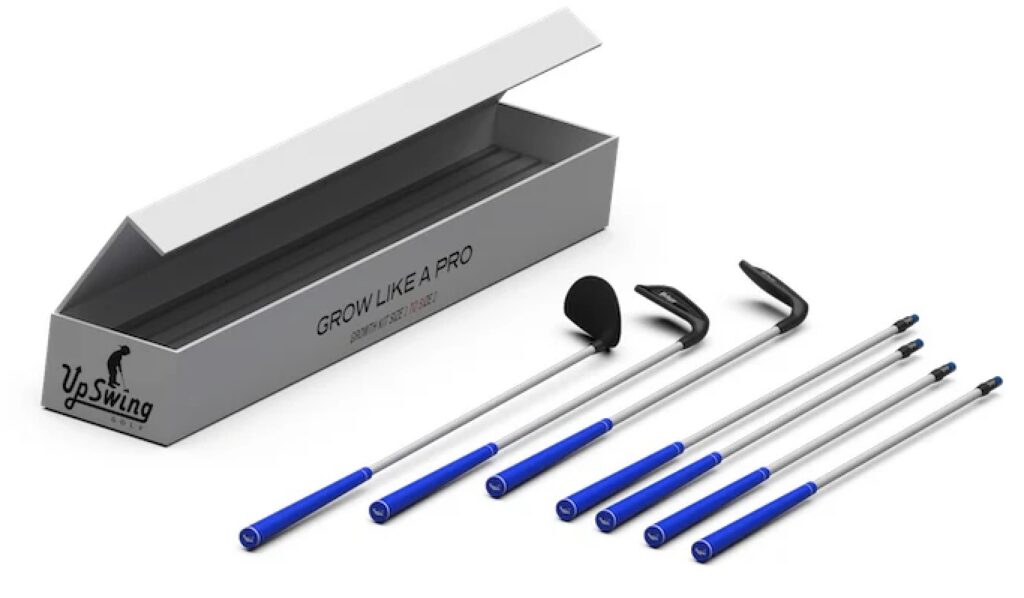
That led to the development of our UpTech platform and the patented Global Mass Property System. Rather than treating the club as a fixed product, we designed the system so that the mass and performance characteristics of the club can progressively change as the golfer develops. The clubhead weighting moves from heel to toe through the different stages, helping the equipment evolve alongside the player.
There was a significant amount of prototyping and testing involved. We had to make sure the mechanism was robust enough for everyday use, while also keeping the clubs lightweight, playable and visually appealing to young golfers. Just as importantly, the system had to be straightforward for parents and coaches to understand and use.
Justin: The commercial challenge was making all of that sophisticated engineering practical and accessible. We didn’t want to create a technically impressive product that was complicated or prohibitively expensive. The objective was to develop a premium junior golf system that could provide a genuine performance benefit while also representing a better long-term investment for parents.
Ultimately, turning the original idea into a commercial product was about finding the right balance between engineering, performance, usability and cost. That’s what has shaped UpSwing into the system it is today.

The ‘Grow like a Pro’ concept potentially changes the traditional junior equipment replacement cycle. How do you see the upgrade-kit and shaft-upgrade model developing, and what does it mean for customer lifetime value and repeat business for retailers?
Justin: We see the upgrade model as one of the most important parts of the UpSwing proposition, because it changes the relationship between the golfer, the parent and the retailer. Traditionally, a junior golfer can outgrow a complete set relatively quickly, meaning the parent has to make another significant purchase and the retailer effectively starts the sales process again from zero.
With UpSwing, the foundation of the system stays with the golfer, while the equipment can be upgraded as they grow. That means a parent isn’t necessarily replacing an entire set every time their child moves into the next stage of development. Instead, they can invest in an upgrade kit or new shaft when appropriate, allowing the golfer to continue using equipment they are already familiar and comfortable with.
For retailers, we see that creating a much more attractive long-term customer relationship. The initial set becomes the starting point rather than the end of the transaction, with natural opportunities to bring the customer back as the golfer develops. That has the potential to increase customer lifetime value while also making the purchasing decision more compelling for parents. They are investing in a system that can evolve with their child, rather than repeatedly buying complete sets.
Our ambition is for UpSwing to establish a new replacement cycle in junior golf – one based on progression and upgrading rather than complete replacement. If we can achieve that, it benefits everyone: the golfer gets appropriately sized equipment throughout their development, parents get greater value from their investment, and retailers have more opportunities to build a lasting relationship with the customer.

How did you go about selecting your manufacturing partners?
Kevin: Manufacturing was an important part of the development process because the engineering and design only have value if we can reproduce that performance consistently at scale. We spent considerable time identifying manufacturing partners with the technical capability, quality standards and experience required to produce a product with the tolerances and consistency our system demands.
Our selection process wasn’t simply about finding a manufacturer that could produce golf clubs at the right price. We needed partners who could understand the engineering behind UpTech, work to very precise specifications and maintain consistency across the different components of the system. That was particularly important because our clubs incorporate proprietary technology, including the weighted adaptor system that allows us to maintain the correct swing characteristics as the golfer moves through different shaft lengths.
We worked closely with our manufacturing partners throughout the development and prototyping process, refining both the components and the production methods before moving into commercial production. Quality control is a major priority for us because we’re asking parents to invest in a premium system that their child can use and develop with over several years.
As we grow, maintaining that consistency will remain just as important as increasing production capacity. We want UpSwing to be recognised not only for the innovation of the concept, but for the quality and performance of the finished product.
You have positioned UpSwing between conventional entry-level junior sets and the premium brands. How have retailers and customers responded to the price points that you have gone with?
Kevin: The positioning is very important to the UpSwing business model. We believe we offer a high-quality product at a mid-grade price point, giving parents access to genuine technology, performance and longevity without making the initial investment prohibitive. Our products aren’t cheap to make, but the UpTech system allows us to manage the price points in a way that delivers a significant long-term benefit to the customer.
The clubhead is the most expensive component of the system, and because UpSwing allows the golfer to retain and develop the clubhead as they grow, parents aren’t continually having to replace the most valuable part of the equipment. That gives the price point a very different context – they are investing in a system designed to grow with their child, rather than repeatedly buying complete sets.
The response from retailers and customers has been very encouraging, particularly once they understand how UpTech works and the longer-term value it provides.

What are your entry routes to market?
Justin: Our initial route to market is a combination of direct-to-consumer, selected high street golf retailers and specialist golf retail, with a particular focus on building relationships with PGA Professionals and pro shops. That gives us the opportunity to explain the UpSwing concept properly and demonstrate the benefits of a system that grows with the golfer.
As we build awareness, we see specialist golf retailers as an important part of our long-term strategy. The product offers retailers a different proposition in junior golf, with the potential to build an ongoing relationship with families as the golfer progresses through the UpSwing system.
What are your priorities for building the brand over the next two to three years?
Justin: Our priority over the next two to three years is to build UpSwing as a recognised name in junior golf and establish the ‘Grow like a Pro’ concept as a genuine alternative to the traditional junior equipment model. That means continuing to develop the product, expand our retail and PGA Professional network, and build awareness among parents and young golfers.
We also see significant opportunities internationally. As we grow, our focus will be on developing the right distribution partnerships, supporting our retail partners and continuing to demonstrate that better-fitted, progressive equipment can make a real difference to a young golfer’s development.
How big do you believe the potential market is for UpSwing across the world?
Justin: We believe the potential market is significantly bigger than the US and Europe. Junior golf is a global market, and the challenge we are addressing – children growing out of their equipment – exists wherever young golfers are playing the game. We see strong potential in markets such as Asia, the Middle East and Australasia, particularly where golf participation and junior development is growing.
Our approach to international expansion will be flexible and market specific. Distributors will be an important part of that strategy, particularly where local market knowledge and established retail networks are essential, while in some markets direct relationships with retailers and consumers may make more sense.
The priority is to work with the right partners who understand the UpSwing proposition and can build the brand properly rather than simply focusing on volume.
Looking five years ahead, what does success look like for UpSwing Golf?
Justin: Success for UpSwing Golf in that time frame would mean growth on multiple levels. First, consumer reach: seeing UpSwing equipment in the hands of young golfers around the world, supported by strong retail, distribution and PGA Professional networks that make our system easy to discover, fit and upgrade.
Kevin: Innovation will be another key measure of success. We want to continue building beyond the products we offer today, expanding the UpSwing platform, developing new equipment categories and solving more of the challenges families and young golfers face as players develop.
One of our biggest strengths is our ability to listen and respond to the market. We have the flexibility to hear directly from customers and quickly adapt, whether that means adding physical products, developing new solutions or introducing programmes that address specific needs. We don’t simply want to sell more of one product; we want to reach more golfers globally while continuing to move junior golf equipment forward.
Retailers and distributors interested in finding out more about UpSwing or exploring distribution opportunities are invited to contact Apex Sports Distribution via www.apexsportsdistribution.co.uk or enquiries@apexsportsdistribution.co.uk.