

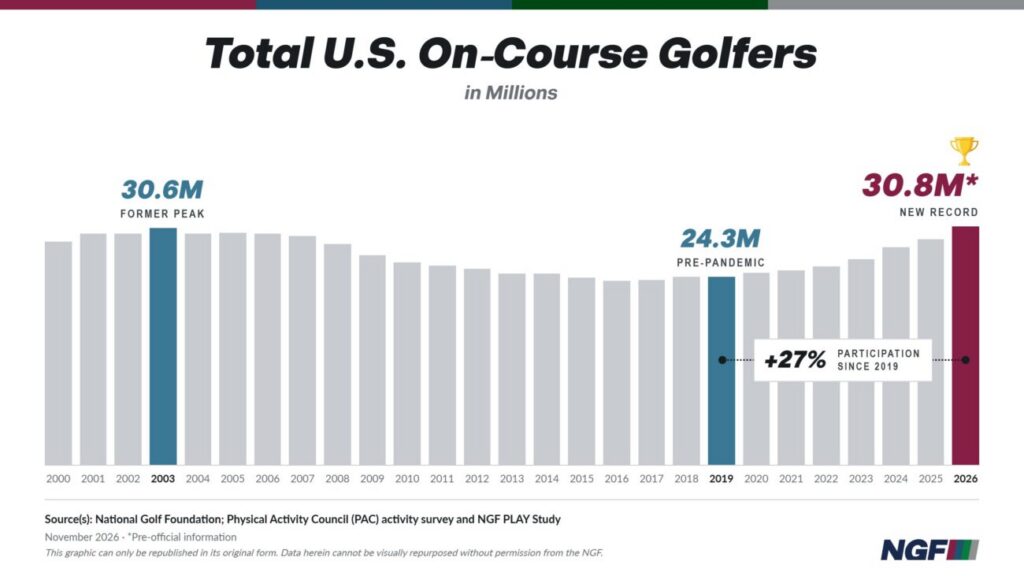
An estimated 30.8 million Americans have played golf on a course in 2026, new research from the National Golf Foundation shows.
That represents an increase of 1.7 million golfers over 2025 and passes the previous record of 30.6 million set in 2003, at the height of the Tiger Woods boom.
The 1.7 million net gain is the second-largest one-year increase on record. On-course participation is now up 6.5 million golfers, or 27%, since 2019, prior to the pandemic.
Those figures have to be taken in context that the US had 2,000 more golf courses in 2003 than it does today.
Off-course participation established a record of its own in 2026, with 39.6 million Americans engaging with the game at locations such as driving ranges, indoor simulators and golf entertainment venues.
Off-course participation has set a new high each year since NGF began tracking it in 2014. Growth has levelled off after a sharp early rise, largely because fewer new large golf entertainment venues have opened in recent years. Simulators, however, keep spreading, in commercial locations, at golf courses and in homes.
That kind of off-course audience didn’t exist during the Tiger boom. Around the 2003 peak, off-course golf mostly meant the driving range, with an estimated 5 to 6 million range-exclusive participants.
Counting on-course and off-course golf together, 49.5 million people played golf in 2026, another all-time high.
More and more golfers now play both forms of the game. These dual participants play traditional green-grass golf and also take part in some form of off-course golf. More than two-thirds of on-course golfers also play non-traditional forms of the game. Their numbers are up 42% since 2019 and 11% since 2024.
People who play on and off course are also among the game’s most engaged participants. Compared with other golfers, they play more often and spend more on the game. Taken together, the 2026 numbers show a bigger and broader golf audience than ever – setting new records both on the course and off it.