

Latest research commissioned by EDGA suggests the clear market opportunity for significant growth in golf via golf for the disabled.
The new research, carried out by industry-leading research experts Sporting Insights, provides valuable evidence to inform strategic decision-making by EDGA and its partners, including national federations, and can help the market attract and retain individuals with a disability to the sport of golf.
Research estimates potential value market growth of £265 million each year in GB&I alone from all golfers.
Sporting Insights carried out the survey in the UK, Europe and other global regions in the second half of 2025, engaging with golfers and non-golfers with a disability, including those registered with EDGA (the European Disabled Golf Association).
The survey’s findings support EDGA’s simple strategy of creating greater opportunities for more people with a disability to enjoy golf – and to experience what is a life-enhancing game.
EDGA is an acknowledged international authority in the G4D space and research is a core part of its work: this latest study sitting within an established programme of evidence-led insight that EDGA shares internationally as a not-for-profit volunteer-led organisation.
Three core reports have been compiled including a summary of G4D in the Home Nations, a survey of EDGA players, and findings related to the ‘Strategic Opportunity: Untapped Growth Potential’ in G4D.
The reports highlight that a great many more people with a disability could experience golf through more targeted support from public and private organisations which seek to innovate via sport.
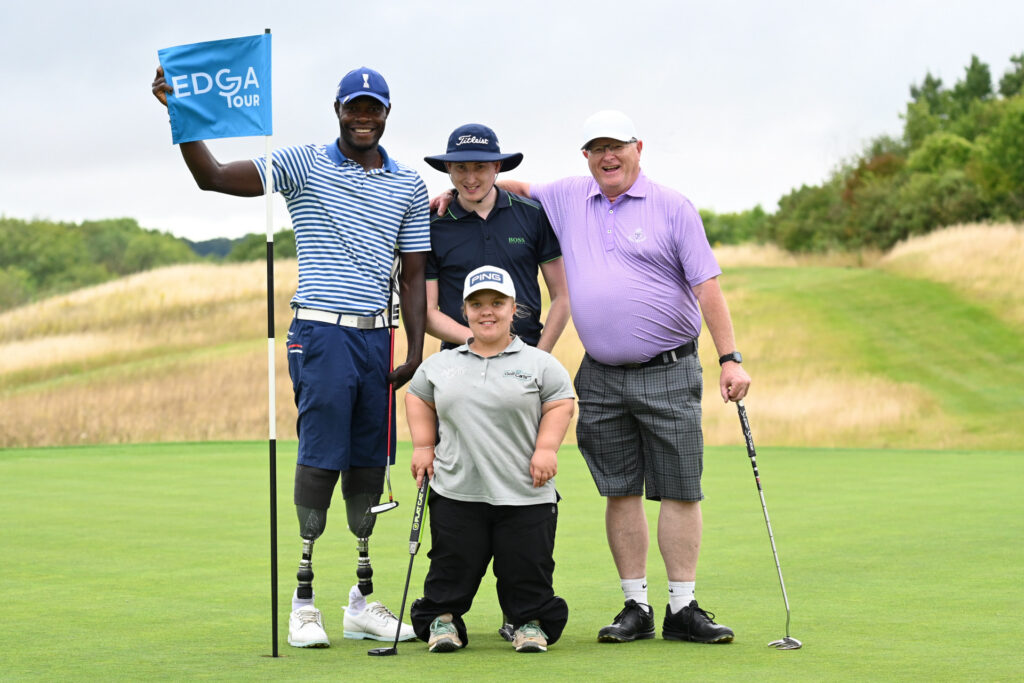
Figures show that 400,000 more people with a health condition, disability or learning difficulty in GB&I can be encouraged to enjoy golf (a jump from a present estimated 1.3 million to 1.7 million individuals with a health condition, disability or learning difficulty), bringing an additional £265 million in value to the golf industry and market each year.
Projections indicate that the number of G4D players who would be described as regular golfers could grow from an estimated 362,000 to 476,000 (a 114,000 increase) following targeted improvements in support, accessibility and promotion in golf and the golf infrastructure: this adding £96 million of annual value to the game.
Many of the established G4D players interviewed in the survey (from the UK, Europe and further afield) report the fun, enjoyment and the health benefits golf has given them – in a sport they recognise as being highly inclusive for players with a wide range of health conditions (65% of golfers with a disability in the UK agree or strongly agree that golf is a better sport for people with disabilities than other mainstream sports).
EDGA is working with an increasing number of national federations (50 at present including the Home Unions of GB&I) to help grow the G4D offering, and during the last four years its ‘8-Stage Pathway’, endorsed by The R&A, has been adopted to assist federations.
The Pathway provides support in national competition structure, in the provision of inclusive and safe venues, staff and volunteer training, coach education and community activation. Federations are provided with best practice education on the promotion of G4D and support of the ‘player pathway’ – from the very first golf experience for a player to regular play and the opportunity to compete in tournaments.
Celebrating its 25th anniversary in 2025, EDGA also shares long-held expertise in medical assessment, eligibility and research, player knowledge, tournament and sport classes, and in growing the awareness of G4D with key stakeholders in the game. EDGA is currently working with 12 national PGAs, including the PGA of GB&I.
The value of this strategy is reflected in the Sporting Insights research.
Golfers with a disability are more likely to encourage others to join in the game, driving organic growth, while 66 percent of the surveyed golfers say they will make use of specialised coaching where it is available. Some 28 percent of active golfers took up golf after limitations from their health condition became part of their lives (including the EDGA database of players this is closer to 40 percent amongst UK players).
The research data flagged up some of the barriers for people joining the game around cost, access, attitudes, awareness and adaptation. Golf has a higher proportion of male participants, despite the disabled population being 52 percent female.
Younger people with disabilities are engaging with golf, but mental health conditions, ASD, communication and learning differences, are more prevalent within this group, which can mean that without direct support young players can miss the opportunity to try the game.
The findings reinforce that EDGA’s core areas of work remain well aligned with demonstrable need and opportunity, including:
- Structured pathways post diagnosis are effective and should be expanded;
- Perception remains a primary constraint, not capability;
- Coaching, education and workforce development are central to sustainable growth;
- There is untapped potential among multiple groups, including women and younger people with a range of disabilities.
The research shows that access to appropriate coaching and informed environments materially influences retention and progression. With appropriate adaptation, golf also offers a viable pathway for older people to remain active for longer.
Other notes of interest include:
- When considering golfers with a disability in the UK, including those UK golfers on the EDGA database, most golfers describe their experience of golf as positive or very positive;
- 69 percent play sport primarily for fun and enjoyment;
- 70 percent cite improving or maintaining general health as a key motivation;
- 89 percent agree that golf can be enjoyed by people with a wide range of disabilities;
- 85 percent agree that golf can be easily adapted to meet different needs
EDGA President Professor Tony Bennett said: “With 16 percent of the world’s population having a disability and given EDGA’s long-held certainty that golf is such a good sport for the health and wellbeing of its players, we, our partners and national federations, have been convinced of this market opportunity, which is now reflected in this excellent detailed research by Sporting Insights.
“We at EDGA have been very much aware that the game needs to attract more women and young people with diverse health conditions and disability, while at the same time supporting an ageing population to continue enjoying the game. These are genuine challenges but massive opportunities alongside the societal change that is occurring around us, where a new generation of consumers with disability rightly demand more as customers.”
Prof. Bennett added: “EDGA believes the survey results indicate a major strategic opportunity around the untapped growth potential in the golf market, and how golf can build on the inclusive nature of the sport if barriers are addressed; in so doing enhancing the wellbeing of many more people.”
Report details
The research included both golfers and non-golfers with a health condition, disability or learning difficulty from the UK, Europe, and other global regions.
The research programme completing the survey included the following respondents:
- 1,001 UK residents who have a physical or mental health condition or learning difference
- 1,503 nationally representative sample of UK adults
- 523 contacts from the EGDA database – 135 UK, 168 Europe, 220 Rest of the World
Three core reports were produced:
- Home Union Summary (November 2025):
UK focused insight into participation patterns, timing of engagement and comparisons with other sports. - Making the Case for Golf for the Disabled (November 2025):
Market sizing, participation potential and economic impact analysis. - EDGA Database Survey Data (November 2025):
Insight drawn from golfers already engaged with EDGA, including competitive and more severely disabled players.
Tony Bennett concluded: “We can now evidence the scale of the opportunity. The next stage is to turn that evidence into action that makes a difference.
“Golf can reach hundreds of thousands more people, while strengthening the sport socially and commercially and helping to break down worn-out perceptions that the game is exclusive. We can do this by working together to remove barriers, improve access and create better pathways into the game.
“For the golf industry, the question can no longer be whether the opportunity exists, but how we position our respective organisations to turn that opportunity into meaningful change.”
To learn more about the research, EDGA’s work or how your organisation can support the growth of G4D, contact EDGA or visit edgagolf.com.