Is it just my imagination, writes John Cockayne, or have regional tourism marketing people jumped onto the whales’ band wagon?
I bring this matter up, because I have been viewing properties on the lower south coast in KwaZulu-Natal (KZN), as I have decided to stay here, and so I am looking for a pied a terre, which I can call home.
Anyway, in this process, when I have been shown a property with impressive sea views, this will be accompanied by the almost inevitable remark; ‘of course you will see whales from here’.
Finally, after living with 140 degree sea views in Ramsgate (the one on the coast of KwaZulu-Natal in South Africa!), since April, and having never seen a glimpse of a tail tip, or even the lingering vestiges of a waterspout, I eventually ‘snapped’– ‘whales – you must be joking, the only time I am likely to ever see Wales, is when I get back to the UK, hire a car and drive in a westerly direction for about 3 hours!’
I continued – ‘I have got more chance of seeing a unicorn prancing into my local Spar supermarket, than I have of ever seeing a whale down here!’
Ho hum – it’s probably simple enough, in that the word is out, and the whales know I am here, and looking for them, so each pod gets into a huddle just off Shelly Beach, takes a collective deep breath, and then dives under the surface, only to come up again near Port Edward!
The looks of incredulity to my negative response, have to be seen to be believed, and usually prompt the – ‘well you must have seen dolphins – surely!?’
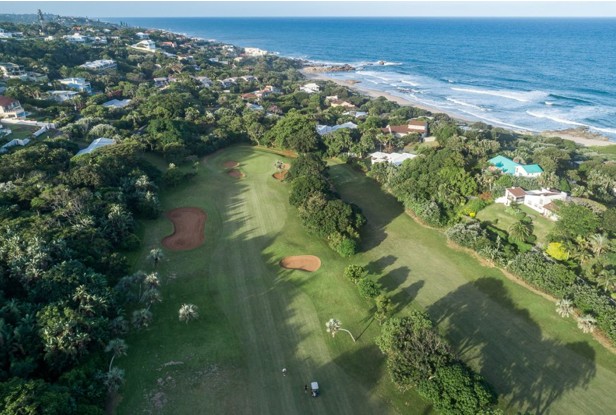
15th hole at Southbroom Golf Club – and there are no whales or dolphins in this picture!
Sadly, this is the same scenario as that with the whales – not a fin tip in sight, which now suggests that it might be a collective conspiracy, with the whales and dolphins remaining incognito (very successfully!) on porpoise!
Mind you, they must be around, or everyone is delusional, and when you think about it, all this talk of whales is very tempting in a marketing sense – I mean, just look how much local, and international, traction Hermanus, in the Western Cape of South Africa, gets from its association with these giants of the deep!
Talking of ‘deep’ – the rainfall levels have been rising in this part of the world, with another wet December, and more of the same forecast through January for Gauteng, where I arrived at the Sandton Sun & Towers, to spend Christmas 2025 and see in the New Year.
This trip has become something of a tradition, and a very nice one too!
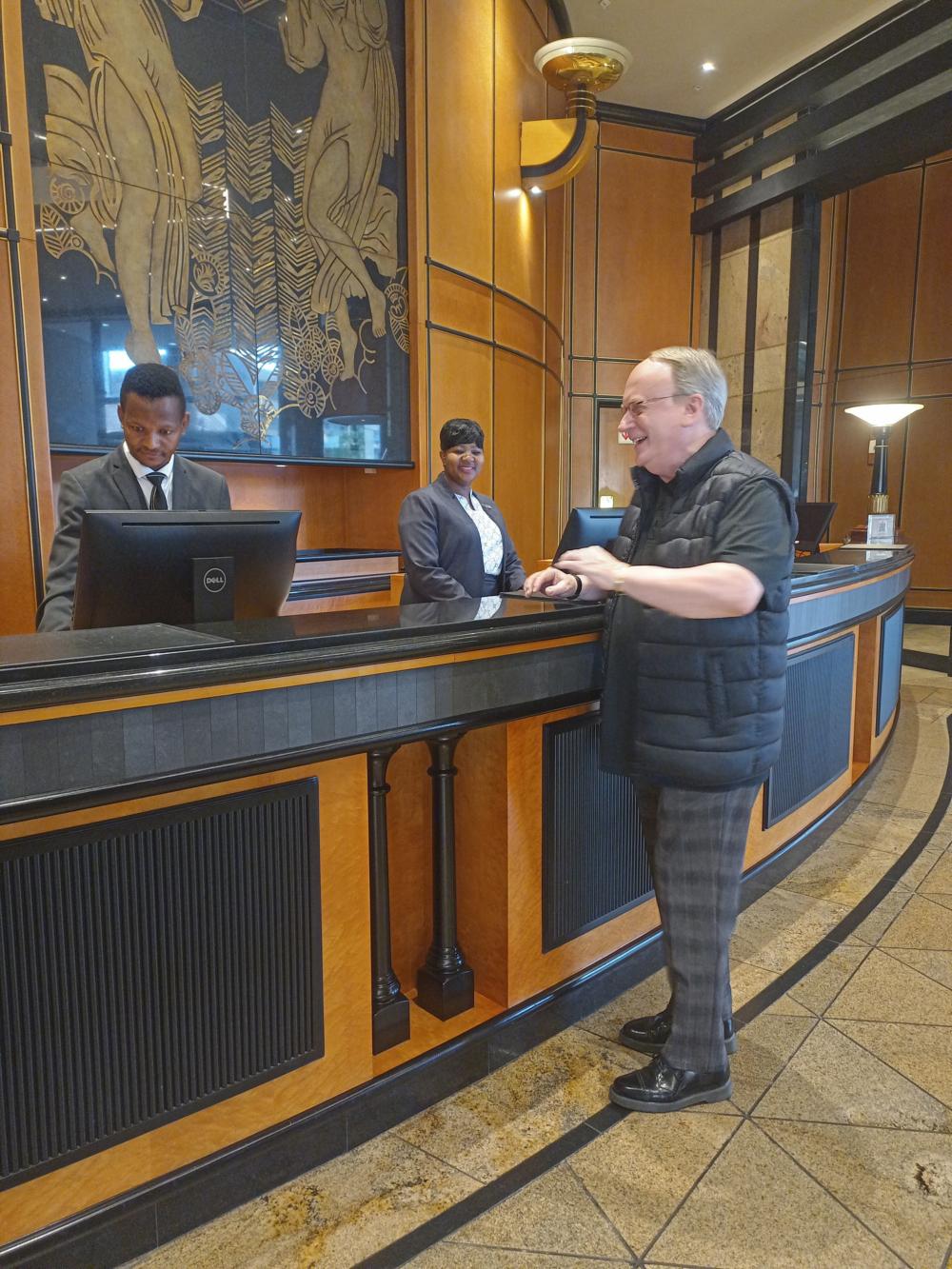
I don’t normally leave for the drive up (or any other drive – golf included!), until about 09h00, and the morning peak traffic has died down, and my blood sugar levels have gone up!
Based on a similar rationale, early tee off times when I was playing the Sunshine Circuit were dreaded – especially those slots where the starter would ask you to shake the trees, as you went down the first fairway, in order to wake up the birds!
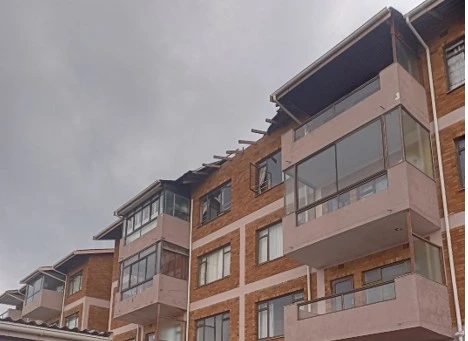
But, I digress, and getting back to the deep-water thread, the recent storms and rain on the coast have been something to behold, and the winds were so strong on Sunday 21 December that they tore the roof off the apartment next to mine – see image below.
That said, heavy though it has been, the rainfall we have experienced pales into insignificance when we stop to look at other regions, such as Thailand and the Philippines, which have been absolutely inundated in recent weeks.
These deep waters (in a metaphorical sense in this case), also adversely impact the golf economy, which is fragile in many parts of the world, and coastal regions such as ours on the south coast of KZN are no exception, with many businesses and golf courses very dependent on a good year-end holiday season, to help them make it through the year, and with inclement weather, the rounds are soon down, along with the footfall, and the tills fall ominously silent!
Having ‘escaped’ from our stormy eastern coastline, it soon became clear that the wet weather had been widespread, as I was not able to differentiate between the borders of KwaZulu-Natal and the Free State, which is strange.
Strange because the usual pattern on the drive, will see me coming over the final part of the Drakensberg, and travelling westwards, into the much less hilly terrain of the highveld.
Then, about 45 minutes, or so, from Harrismith (a large town in the Free State province of South Africa, which was named for Sir Harry Smith, a 19th-century British governor and high commissioner), and just as you start to pick up fragmented signals from Highveld Radio, the green of KZN will have be replaced by a much browner landscape, where the vivid green of the coastal province will now only be seen in irrigated areas of cultivated farmland, along watercourses, or around the numerous farm dams.
Not so this year, and if it were possible – it might well have been a trick of the light – but if anything, the Free State looked greener than KZN, the cattle seemed to be belly deep in lush grass (and looking very happy for it – if cows can look happy!), and the highway’s verge was resplendent with wild flowers, including the ubiquitous cosmos.
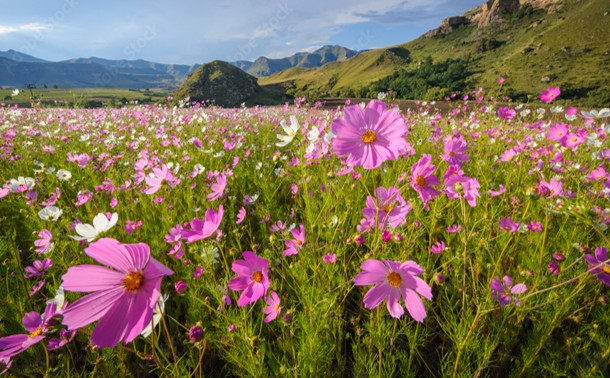
The grassland wildflowers of the Drakensberg mountains, stretching from Eastern Cape through KwaZulu-Natal and from the Free State into Mpumalanga, only peak in late spring (November), so really I was too far into the tail-end of the season to get the full benefit of this ‘bloom’, but then there is another – some say even more spectacular – wave of flowering that takes place in late summer and into autumn – January to March, and I caught the start of that show when I drove back to KZN in early 2026.
What makes this region particularly good for wildflower enthusiasts and nature lovers in general, is that more than half of our wildflowers – 10 000 species in all – occur in grasslands and savannahs, and to put this number into a relatable context, the United Kingdom has about 1600 species of wildflowers.
It is interesting to note that in South Africa, many golf course are trying to reduce their maintained footprint – both for economic and environmental reasons – and are planting indigenous wild grasses and wildflowers, in areas which had previously been manicured and closely cut.
Wishing all Golf Business News readers a healthy and happy 2026!
Any of Golf Business News’ readers who are planning a trip down to Southern Africa, whether on business or pleasure, are most welcome to contact our Africa columnist, and the author of Letters from Africa – John Cockayne.
You will be under no obligation, and John will be more than happy to help you with advice on, and information about South Africa – so, if you need to know anything about the region, just contact John, who can be reached on email: dainfern57@gmail.com or by mobile phone on +27 (0) 73 896 7931